TheElliotWatson.GRILLUST.UK
  • Home
  • About
  • Blog
  • Contact
  • University Projects
    • Year 2 Project Links
    • Year 3 Project Links

A Totally Legitimate Art Blog

History & Practice: Japanese Art's Influence on European Art and Design in the late 19th Century

6/10/2019

0 Comments

 
Japan spent over 220 years with closed borders and limited trade policies enacted in the 17th century. This policy was established off the back of the sengoku jidai, "age of civil war", resulting in a unified Japan after 148 years of military conflicts.
Japan's self-imposed isolationist policy towards global affairs was forcibly ended by America via two warships in 1853, resulting in Japan trading with America (at cannon-point). This trade opened up Japanese goods and culture to the western world.

Claude Monet - Case Study

Claude Monet:
  • Born in Paris, France - 1840
  • French Painter
  • Founding Impressionist
  • Died in Giverny, France - 1926
Picture
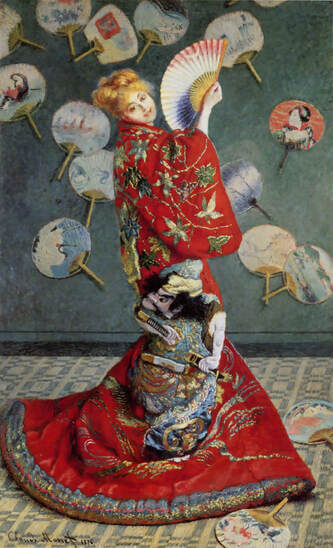
Madame Monet in a Japanese Kimono, 1875 - Claude Monet
In this example of Japan's influence on Art, the content heavily features Japanese items, the Kimono, and the rather excessive number of uchiwa upon the wall and floor. However the style of the piece retains a more traditionally western technique and aesthetic.
Picture
Madame Monet and her Son, 1875 - Claude Monet
In contrast to Monet's shocking Japanese fan collection, this painting is western in its form and content, featuring Monet's Impressionist style depicting contemporary French fashion in a French setting.

Vincent Van Gogh - Case Study

Vincent Van Gogh:
  • Born in Groot-Zundert, Netherlands - 1853
  • Dutch Painter
  • Post-Impressionist
  • Died Auvers-sur-Oise, France  - 1890
Picture
Courtesan, 1887 - Vincent Van Gogh
This is a pretty hard gotcha for Van Gogh, as this painting features a very Japanese figure with the same pose as an original Japanese print (see right).
However, Van Gogh has changed several elements from the original, transforming it in the process. The inclusion of a painted background is a great departure from the original, as well as several changes in details of the figure.
Picture
Beauty and Sumida River, ~1810 - 1820 - Keisai Eisen
The original print Van Gogh is drawing from, like many Japanese prints appears on a minimal canvas, leaving the figure to float in space free from unnecessary detail.
Picture
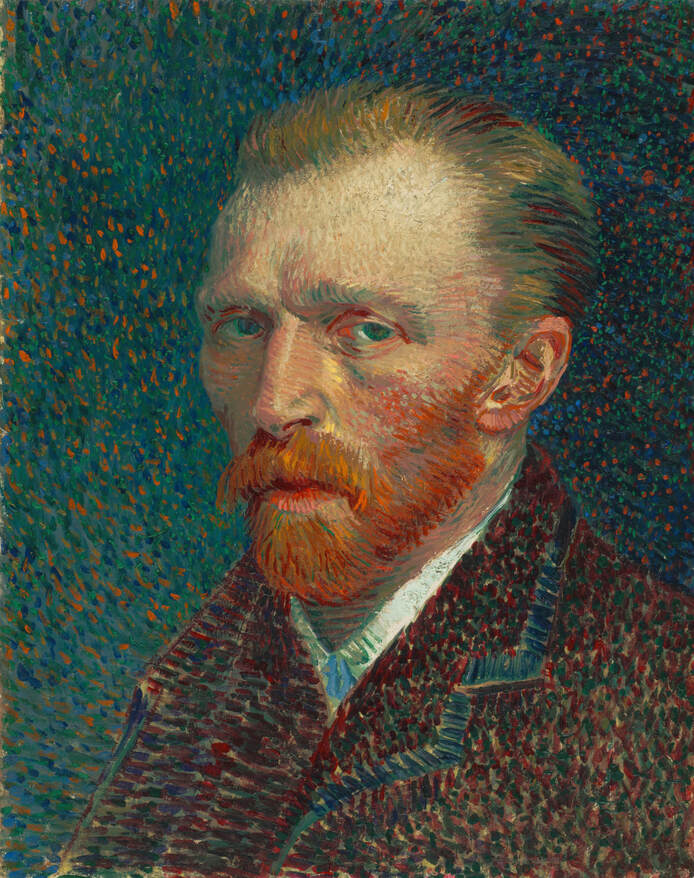
Self Portrait, 1887 - Vincent Van Gogh
In contrast to Van Gogh's swamp-integrated Courtesan, this self portrait features the use of a western painting technique, Pointillism, far from the clear and clean lines of Japanese prints.
​Pointillism developed in France focusing on colour-theory, contrasting colours, and many smaller marks constructing the painting as a whole.
Japanese woodblock prints tend to feature a relatively limited colour palette, especially when compared to the plethora of hues present in a pointillist painting.
Colours present on woodblock prints are very flat, whereas pointillist colours convey a range of textures and depth.
Sources
0 Comments


Leave a Reply.

    Author:

    Elliot Watson, Illustrator with a background in historical swordsmanship and all the weird and wonderful trappings that entails.

    Archives

    November 2021
    October 2021
    September 2021
    May 2021
    April 2021
    March 2021
    February 2021
    December 2020
    November 2020
    October 2020
    April 2020
    March 2020
    January 2020
    December 2019
    November 2019
    October 2019
    September 2019

    Categories

    All

    RSS Feed

Site powered by Weebly. Managed by 34SP.com
  • Home
  • About
  • Blog
  • Contact
  • University Projects
    • Year 2 Project Links
    • Year 3 Project Links